

Table of Contents
- Why Rust Attacks Woodworking Tools and What It Costs You
- What Makes a Good Rust Preventative for Woodworking Tools
- How to Remove Rust from Precision Hand Tools
- Best Oil for Cast Iron Table Saw Tops
- Wax, Oil or Vapour: Comparing the Main Options
- Damp Workshop Storage and Prevention Routine
- How Precision Tools Fit Into Your Rust Prevention Routine
- Conclusion
- Frequently Asked Questions
Last Updated: October 2, 2026
Why Rust Attacks Woodworking Tools and What It Costs You
Finding the best rust preventative for woodworking tools starts with understanding what you are actually fighting. Rust is iron oxide, formed when moisture and oxygen reach bare steel. In an unheated workshop or a van parked overnight, condensation settles on cold cast iron and carbon steel surfaces long before you notice it.
The damage is rarely dramatic. It shows up as a dull bloom on a table saw top, a stiff lever on a marking gauge, or a speckled patch on a chisel back that will not lap flat. Left alone, pitting removes metal permanently. A rusted reference face on a square or a plane sole is no longer a reference face.
This guide from DeFrixo covers why tools corrode, how to remove existing rust without wrecking precision surfaces, and how to build a prevention routine that survives a damp British winter. Health and Safety Executive guidance on workshop conditions is worth reading if your workspace is a garage or outbuilding, since ventilation affects both moisture and your exposure to solvents.
What Makes a Good Rust Preventative for Woodworking Tools
A good rust preventative is a product that blocks moisture and oxygen from reaching bare steel, stays put on vertical surfaces, and does not contaminate wood or interfere with tool function. That last point matters more than most guides admit.
Woodworking adds a constraint that general metalworking does not. Anything you apply to a plane sole, a saw top, or a chisel will eventually transfer to timber. Silicone-based protectors are the classic mistake here. They feel effective on steel, but trace silicone on a board ruins a finish and can stop glue from taking.
Three properties separate a product that works from one that sits unused on a shelf:
- Film persistence. It must still be there next week, not just next hour.
- Wood safety. Once dry, it should not stain, raise grain, or repel finishes.
- Reversibility. You need to be able to remove it before applying a finish or when it gets gummy.
The best rust preventative for woodworking tools is therefore a compromise between protection and cleanliness, and the right answer changes depending on whether a tool is used daily or stored for months.
How to Remove Rust from Precision Hand Tools
Remove rust from precision hand tools by starting with the least aggressive method that works, and only escalating when the corrosion is deeper than surface bloom. Precision tools punish impatience. A flat surface that gets dished by over-zealous abrasion is worse than a cosmetic stain.
Start by identifying what you have. Light surface rust wipes away. Black rust or pitting has already removed metal and needs a different approach.
Work in this order:
- Clean the tool with a degreaser and dry it thoroughly.
- Apply a penetrating oil and let it sit for several minutes.
- Test the gentlest method on an inconspicuous area first.
- Dry completely, then protect immediately. Bare steel flash-rusts fast.
Gentle Methods for Fine Tools
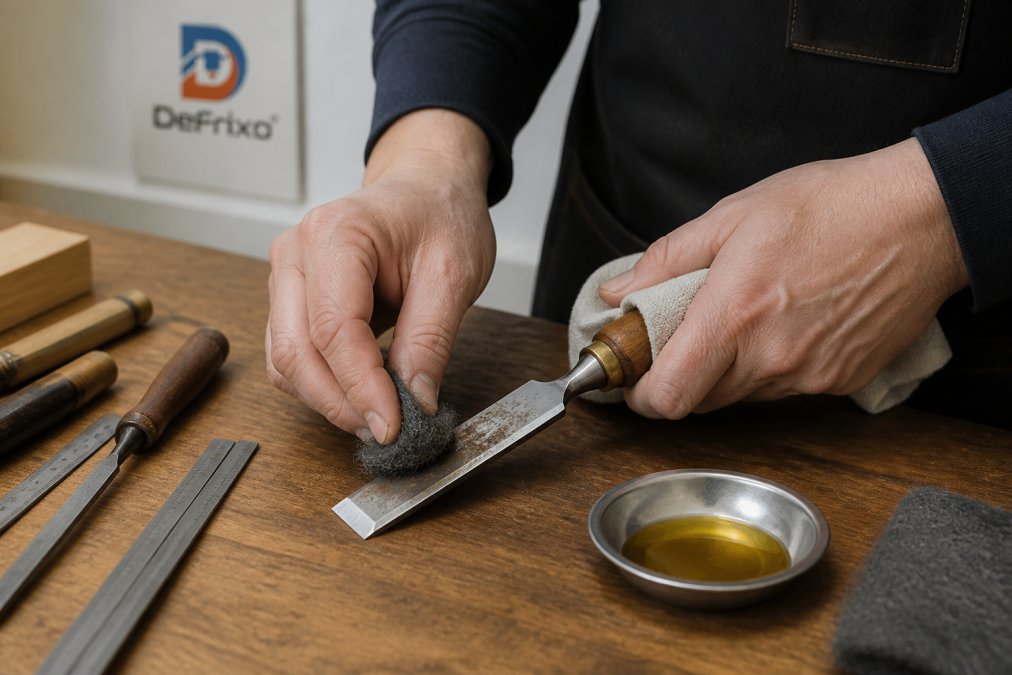
For light bloom on a chisel back, a plane sole, or a square blade, start with oil and fine wire wool, working along the length of the tool rather than across it. A brass or nylon abrasive pad does the same job with less risk of scratching. On a machined surface, a fine abrasive pad used wet with oil lifts surface rust without cutting into the flat.
For anything with a ground reference face, avoid power tools entirely. The whole value of a precision tool is its geometry, and a random orbital sander does not care about geometry.
When to Use Abrasives or Electrolysis
Deeper corrosion needs a step up. Coarser abrasives, rust-removing solutions, or electrolysis all work, but each has trade-offs. Electrolysis is effective on heavily rusted cast iron and on parts you can fully submerge, but it requires a power supply, an electrolyte, and careful setup, and it will not restore pitted metal.
Abrasive methods remove metal by definition. On a table saw top or a machine bed, that is often acceptable. On a precision ground chisel back or a precision square, aggressive abrasion can alter the reference surface and affect accuracy.
Best Oil for Cast Iron Table Saw Tops
The best oil for cast iron table saw tops is a non-drying, wood-safe product that leaves a thin film rather than a wet layer. Cast iron is porous and rusts quickly once its protective coating wears through, so consistency matters more than brand.
Drying oils such as boiled linseed oil cure to a film, which some woodworkers like for long-term storage but which can become tacky in warm workshops. Non-drying oils stay slick but pick up sawdust. Many fitters settle on a light machine oil or a dedicated tool protector, applied thinly and reapplied regularly.
Whatever you choose, apply it after every session where the top has been cleaned or exposed to moisture. A table saw top that gets wiped down and oiled weekly will outlast one that gets oiled twice a year, regardless of which product is on the shelf.
Wax, Oil or Vapour: Comparing the Main Options
Choosing between wax, oil, and vapour-phase protection comes down to how long a tool sits idle and how often you use it. Each method suits a different pattern of work.
Method |
Best For |
Duration |
Wood Safety |
|---|---|---|---|
Paste wax |
Regularly used hand tools and machine tops |
Weeks |
Excellent once buffed |
Non-drying oil |
Cast iron tops, daily-use tools |
Days to weeks |
Good if applied thinly |
Drying oil film |
Long-term storage of hand tools |
Months |
Good once fully cured |
Vapour-phase inhibitor |
Stored tools in enclosed boxes or cabinets |
Months |
Excellent, no contact film |
Wax is the traditional choice for machine tables and plane soles because it protects and lubricates at the same time. Oil wins where you want speed and simplicity.
Damp Workshop Storage and Prevention Routine
Prevention beats removal every time, and a routine takes minutes per week. A damp workshop is the single biggest driver of tool corrosion, and most of the moisture arrives through the air rather than through leaks.
Build a routine around these habits:
- Wipe down every tool after use, especially after handling with bare hands
- Apply a thin protective film to machine tops before leaving for the day
- Store hand tools in a closed cabinet or chest rather than open shelves
- Keep a vapour-phase liner or emitter in storage boxes
- Check for condensation on cold cast iron on mild, damp mornings
- Reapply protection after any cleaning that strips the previous film
How Precision Tools Fit Into Your Rust Prevention Routine
Precision tools deserve their own place in the routine because they are the hardest to replace and the easiest to ruin. A rusted tape measure is an annoyance. A rusted reference square or a pitted chisel back is a genuine loss.
Conclusion
Rust is a slow, quiet problem that shows up as lost accuracy long before it shows up as visible damage. The fix is not one miracle product. It is a routine: clean after use, protect before storage, and match the method to how long a tool sits idle. Get that right and your precision tools will hold their reference surfaces for years.
Frequently Asked Questions
Is wax or oil better for preventing rust on cast iron tools?
It depends on how often you use the tool. Wax, such as a paste wax or a purpose-made protective wax, leaves a dry film that does not transfer to timber and suits surfaces that get regular use. Oil gives longer-lasting protection on tools stored for weeks, but it stays tacky and can stain wood. Many woodworkers use wax on a cast iron table saw top and oil on hand tools kept in a damp workshop. Whichever you choose, apply it thinly and reapply after every session where the tool has been handled.
How do I protect my woodworking tools from rust in a damp workshop?
Control moisture first, then coat the metal. A small dehumidifier or a tube heater running at low output keeps relative humidity down, and a simple hygrometer shows you when it climbs. Store tools in a closed cabinet or drawer rather than open shelves, and add a vapour corrosion inhibitor strip or silica packs. Wipe every bare metal surface with a rust preventative after use, and never put a tool away with damp hands or sawdust clinging to it. Dust holds moisture against the surface.
Can I use WD-40 to prevent rust on woodworking tools?
WD 40 Multi Use Product can displace moisture and leaves a thin protective coating that helps prevent rust and corrosion. For tools stored for extended periods or in consistently damp conditions, a dedicated long term corrosion preventative may provide more durable protection. It also leaves an oily film that can mark timber. For surfaces that touch wood, a dry wax film is usually the safer choice. Keep a water-displacing spray for post-cleaning and use a dedicated preventative for storage.
Do silica gel packs actually work for tool storage?
They help in a sealed space, but they have limits. Silica gel absorbs moisture from the air inside a closed drawer or cabinet, which slows corrosion, but it becomes saturated and stops working. You need to dry it out regularly, usually by warming it, or replace it. For an open workshop or a leaky shed, silica packs alone will not keep rust away. Combine them with a vapour corrosion inhibitor and a surface coating for reliable results.