

Table of Contents
- Why Tool Storage Matters in a Small Workshop
- Wall-Mounted Tool Storage Ideas That Save Floor Space
- Small Workshop Organisation Tips for Hand Tools
- Storing Precision Woodworking Tools Safely
- Mobile Storage Ideas for Tools That Move Between Jobs
- Van and Vehicle Storage for Installers
- Overhead and Under-Bench Storage Solutions
- Choosing the Right Storage for Your Workshop
- Frequently Asked Questions
Last Updated: September 16, 2026
Why Tool Storage Matters in a Small Workshop
Tool storage is the practice of organising hand tools, power tools and precision instruments so they stay protected, visible and quick to reach. In a small workshop, storage is not a tidiness issue; it is a workflow issue. Every minute spent hunting for a chisel or untangling a cable is a minute not spent cutting, drilling or fitting.

This guide from DeFrixo covers the top 10 tool storage ideas for small workshops, from wall-mounted systems to mobile units and van setups. The suggestions below suit professional kitchen fitters, cabinet installers, joiners and serious DIY users working in tight spaces. We will look at what each option does well, where it falls short, and which tool categories it suits best.
Wall-Mounted Tool Storage Ideas That Save Floor Space
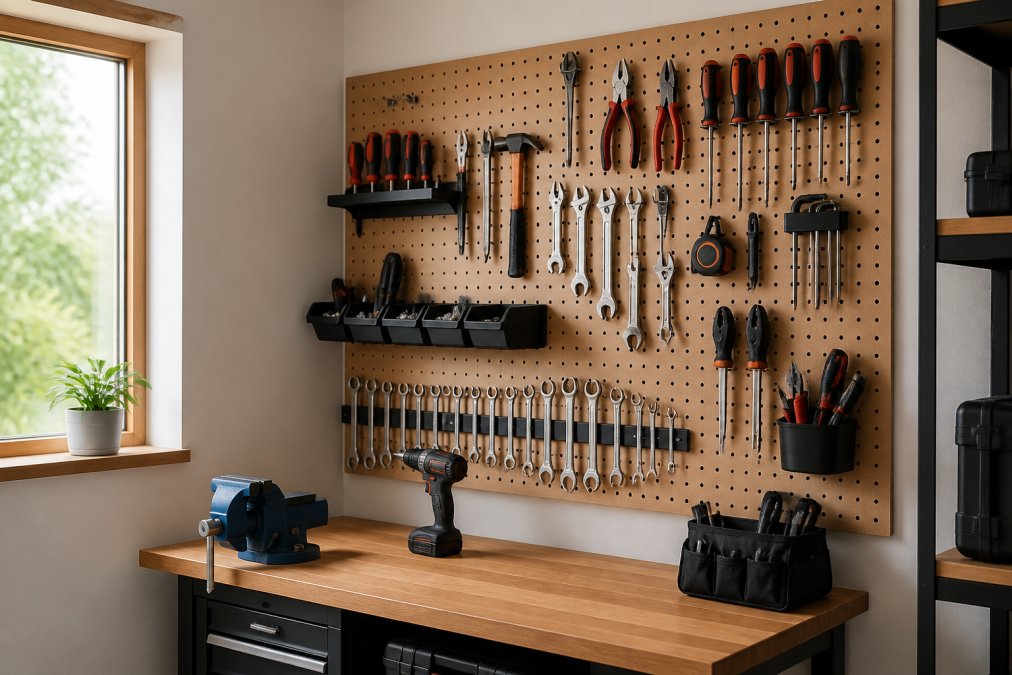
Wall-mounted storage is the fastest way to reclaim floor space in a compact workshop. Two systems dominate: pegboard and slatwall, and magnetic strips and rails.
Pegboard and Slatwall Systems
Pegboard is a panel drilled with evenly spaced holes that accept hooks, bins and brackets. It suits screwdrivers, pliers, hammers, measuring tools and small clamps. Slatwall works on the same principle but uses horizontal grooves, which carry heavier shelves and baskets.
The advantage is flexibility. You rearrange hooks as your tool collection changes. The drawback is that hooks can work loose over time, and heavy items need proper wall fixings, not just panel anchors.
Magnetic Strips and Rail Storage
Magnetic strips hold spanners, screwdrivers, files and other steel tools flat against the wall. They keep edges visible and within arm's reach, which matters when you are swapping tools constantly.
A common mistake is mounting a strip too high or too low. Fit it at chest height so you can lift a tool off without stretching. Magnetic strips work with suitable magnetic metal tools. They are not suitable for aluminium, non magnetic stainless steel or tools without enough magnetic metal for a secure hold.

Small Workshop Organisation Tips for Hand Tools
Hand tool storage rewards a simple rule: one home for every tool. Drawer dividers and shadow foam enforce that rule; tool chests and open shelving offer two different ways to scale it.
Drawer Dividers and Shadow Foam
Shadow foam is a dense foam insert cut to the outline of each tool. When a tool is missing, the empty shape tells you immediately. It protects cutting edges, stops tools sliding into each other, and makes stock checks quick at the end of a job.

Dividers do the same job for less money. Adjustable plastic or wooden dividers suit pliers, chisels, marking tools and fasteners, and they cost a fraction of custom foam.
Tool Chests vs Open Shelving
Tool chests keep everything enclosed, lockable and free of dust. They suit precision instruments and anything you transport between jobs. Open shelving costs less, gives instant visibility and holds bulky items like power tool cases and boxes of fixings.
Option |
Best For |
Main Drawback |
|---|---|---|
Drawer dividers |
Hand tools, fasteners, marking tools |
No protection from dust |
Shadow foam |
Chisels, planes, precision tools |
Fixed layout, costly to redo |
Tool chest |
Transport, security, dust protection |
Takes floor space |
Open shelving |
Power tool cases, bulk storage |
No security, collects dust |
Storing Precision Woodworking Tools Safely
Storing precision woodworking tools safely means protecting them from moisture, impact and rust, then making sure you can find them again. Squares, gauges, marking knives and measuring tools lose accuracy when they are thrown into a general toolbox.
Protective Cases and Dedicated Boxes
Dedicated cases are the simplest protection. A fitted case keeps a tool from knocking against others, and it means the tool goes back to the same place every time. This is the same logic behind the AlignPro Laser Level Marker Storage Box, which holds Lightweight, Heavy Base and Magnetic markers together so they do not roll around a van or get damaged between jobs.
Labelling and Inventory Systems
Labelling is the cheapest upgrade in any workshop. Mark drawers, bins and cases by tool type or by job. A simple inventory list, kept on paper or on your phone, tells you what should be in the van before you leave for a fit.
For installers, a missing spacer gauge or drill guide mid-job costs more than the tool itself. Label it, store it in one place, and check it back in at the end of the day.
Mobile Storage Ideas for Tools That Move Between Jobs
Mobile storage suits tools that travel from the van to the room where you are working. A rolling cabinet, a stackable box system or a heavy-duty bag on castors keeps a job's tools together and saves repeated trips to the vehicle.
The trade-off is footprint. A mobile unit needs clear floor to roll, so plan a route before you load it. Keep the unit loaded by task rather than by tool type: one box for cabinet assembly, one for handle fitting, one for finishing.
Van and Vehicle Storage for Installers
Van storage decides how quickly you start on site. Shelving, drawer units and wall-mounted holders turn a van into a working store, and they stop loose items sliding around in transit.
Small holders make a real difference here. The Clip-On Silicone Tube Wall & Van Holder pushes a sealant tube straight into place for a firm grip, with no straps and no fiddling, and it can be mounted to store tubes nozzle up or down. For installers carrying several cartridges, that removes the mess of tubes rolling across the van floor.
Group van storage by how often you use each item. Daily tools go near the door; job-specific kit goes deeper in. Anything you have not touched in a month probably does not need to travel with you.
Overhead and Under-Bench Storage Solutions
Overhead and under-bench storage uses the space most workshops ignore. Ceiling racks hold long stock, timber offcuts and pipe. Under-bench drawers and pull-out trays hold power tools, cases and bulk fixings.
Weight is the limiting factor. Overhead racks need fixing into joists or a suitable structure, not just plasterboard. Under-bench storage needs clearance for drawers to open, so measure before you build.
A practical approach is to reserve overhead space for items you use weekly, not daily.
Choosing the Right Storage for Your Workshop
Frequently Asked Questions
How do you organise a small workshop with limited space?
Start by using vertical space. Wall-mounted pegboards, magnetic strips and shelving keep tools off the floor and within reach. Group tools by task, so cabinet fitting gear stays together and woodworking tools stay together. Use drawer dividers to stop small items mixing. If you move between jobs, a mobile tool chest on castors lets you take what you need without cluttering the bench. The goal is repeatable placement: every tool has one home, and you can find it without searching.
What is the best way to store hand tools in a small garage?
A combination of wall storage and a rolling tool chest works well. Hang frequently used tools like hammers, squares and screwdrivers on a pegboard at eye level. Store less common items in labelled drawers. Keep chisels and planes in a dedicated drawer with edge protection. For cabinet installation tools such as drilling jigs, a shallow drawer or a wall-mounted holder keeps them accessible without taking bench space. Avoid piling tools in open boxes, which leads to damage and lost time.
How can I keep my cabinet installation tools organised and accessible?
Cabinet installation involves repeatable tasks: drilling handle holes, aligning panels, spacing drawer fronts. Store those tools together in one place, ideally in a case or drawer you can carry to the cabinet. DeFrixo offers a storage box for AlignPro Laser Level Markers that is designed specifically to fit the markers, keeping them organised, protected, and ready for every job. A clip-on silicone tube holder keeps sealant tubes secure in the van or workshop. The principle is simple: tools used together should live together, so you are not hunting across the workshop mid-install.
Are wall-mounted storage systems better for small workshops?
Wall-mounted systems free up floor and bench space, which matters in a small workshop. They also keep tools visible and within reach. However, they are not ideal for heavy items or tools that need protection from dust. A mixed approach works best: wall storage for everyday hand tools, closed drawers or cases for precision equipment, and a mobile chest for tools that travel. Consider what you use daily versus occasionally, and store accordingly.
How do I store precision installation tools to prevent damage?
Precision tools need protection from knocks, dust and moisture. Keep them in dedicated cases or drawers with foam inserts where possible. For laser level markers, a purpose-made storage box is designed specifically to fit the markers, keeping them organised, protected, and ready for every job. Avoid throwing precision tools into a general toolbox where they can be scratched or bent. Label the storage so anyone on site knows where the tools belong. A few seconds returning a tool to its case prevents expensive replacements. A cramped workshop is not a storage problem, it is a planning problem, and the fix is usually a mix of wall, bench and mobile storage rather than one system. At DeFrixo, we build precision installation tools for kitchen fitting, cabinet assembly and woodworking, with fast UK dispatch, 30-day returns and a growing base of installers who use them daily. Shop the AlignPro Laser Level Markers and the rest of the range to give every tool a proper home and every job a faster start.